Public artifacts that show how DossierDock actually works.
If you are evaluating fit before a conversation, start with a live product report example, a plain-language explanation of what a pass means, example export evidence, and the trust materials we can share in qualified diligence conversations. These are operating artifacts, not blanket compliance claims.
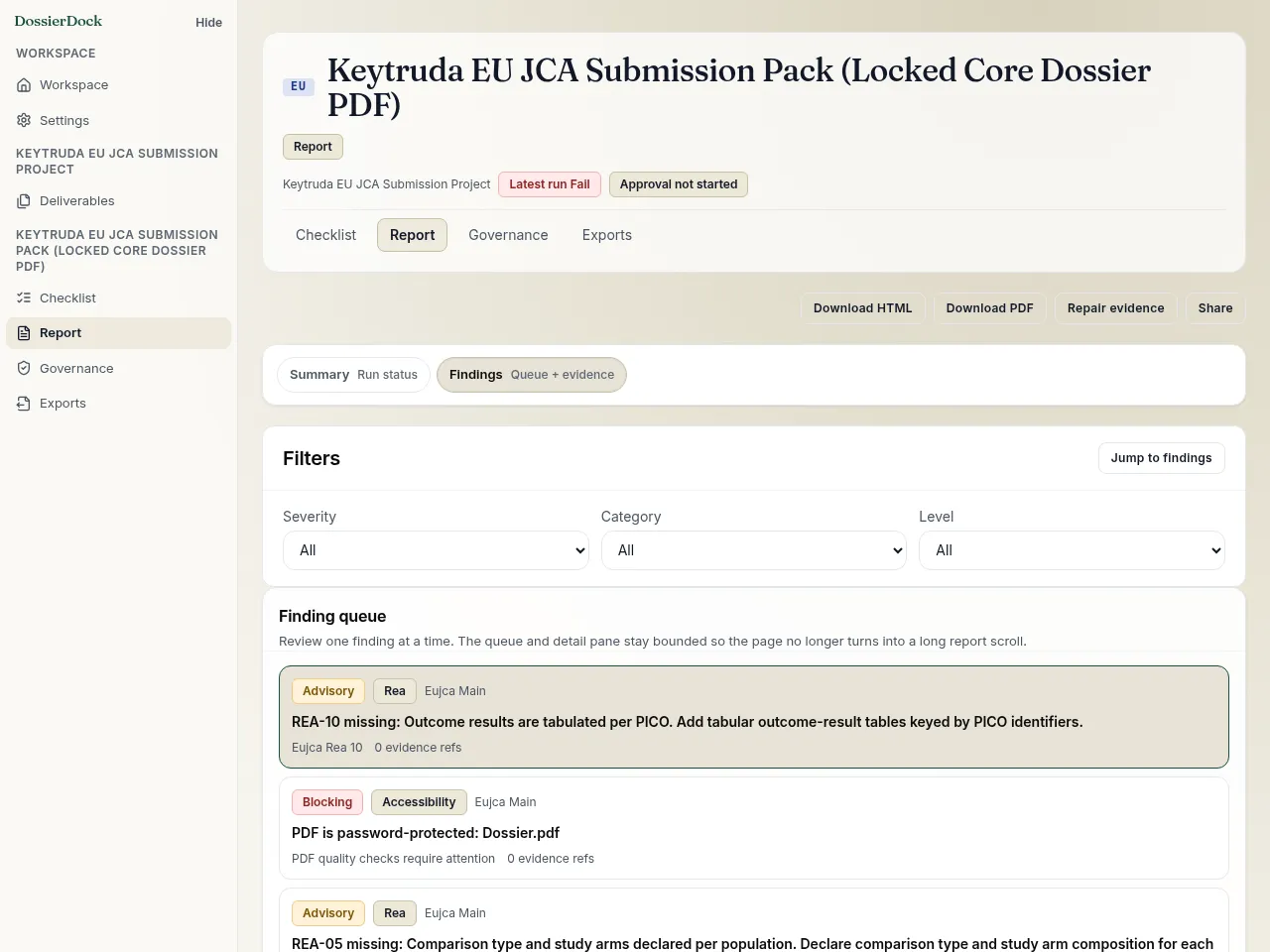
A real report surface, not a marketing sketch.
This example shows the actual report structure: current run status, issue labels, section context, fix guidance, summary views, and the review run it came from.
A pass means the selected review run has no must-fix issues left. Lower-priority notes can still be present and visible.
Findings are written for the person fixing the issue: which section or artifact is affected, what was detected, and what needs to change.
The report stays tied to the selected review run, workflow state, and approval history instead of floating as a detached PDF.
What a PASS result does and does not mean.
No must-fix issues remain for that review run.
The selected run has no remaining issues that stop the pack from moving forward under the checks active for that lane at that time.
Issue type, location, and fix guidance.
Each issue is meant to be acted on quickly and reviewed later with the same wording and context.
A pass does not erase review work.
Lower-priority notes remain visible so teams can improve review quality even when the pack can move forward.
PASS is not scientific, regulatory, or payer acceptance.
The output does not certify clinical correctness, argument quality, regulatory compliance, or downstream payer acceptance. Final submission responsibility stays with the customer team.
Example export evidence you can inspect directly.
DossierDock exports are not just ZIP files. Each export carries review status, a contents record, file fingerprints, and a build record so the package can be traced back to the exact run that produced it.
Example fields include review status, the exact file list, package fingerprint, build version, and artifact inventory.
Example fields include build version, package fingerprint, export fingerprint, and the review status recorded at export time.
The exported package stays tied to the reviewed state instead of a manually assembled folder with no clear history.
Review snapshots and submission flows can carry direct traceability downloads and verification files alongside the package itself.
These are sanitized public examples based on the same export records used by the product.
What qualified diligence conversations can review.
We do not publish fake badges or blanket compliance claims. For qualified pilot and diligence conversations, we can walk through a trust package built around concrete operating artifacts and explicit control status.
Hosting and data-location summary, access-control summary, change-management summary, and incident-response summary.
Subprocessor register, BC/DR summary, restore-rehearsal summary, and transfer-mechanism posture.
SIG Lite master responses, CAIQ or questionnaire crosswalks, and evidence-index packaging for buyer review.
Focused pilots are usually scoped around one live workflow or one to two deliverables. Typical measurable outcomes include must-fix issues caught before reviewer handoff, less review-week rework, and faster time from first upload to approved export.
Want to inspect the live workflow after the public proof?
We can walk through the same report, governance, and export surfaces against the workflow your team actually uses.