Submission controls that hold up under real review pressure.
The current product centers on workspace triage, guided onboarding, checklist mapping, report review, governance, and governed exports. The point is to catch structural defects earlier, keep approvals tied to current inputs, and build exports with a clearer audit trail.
The product teams can run today.
The lane starts with triage and setup, but the working proof is clear report review, governed approvals, secure sharing, and export.
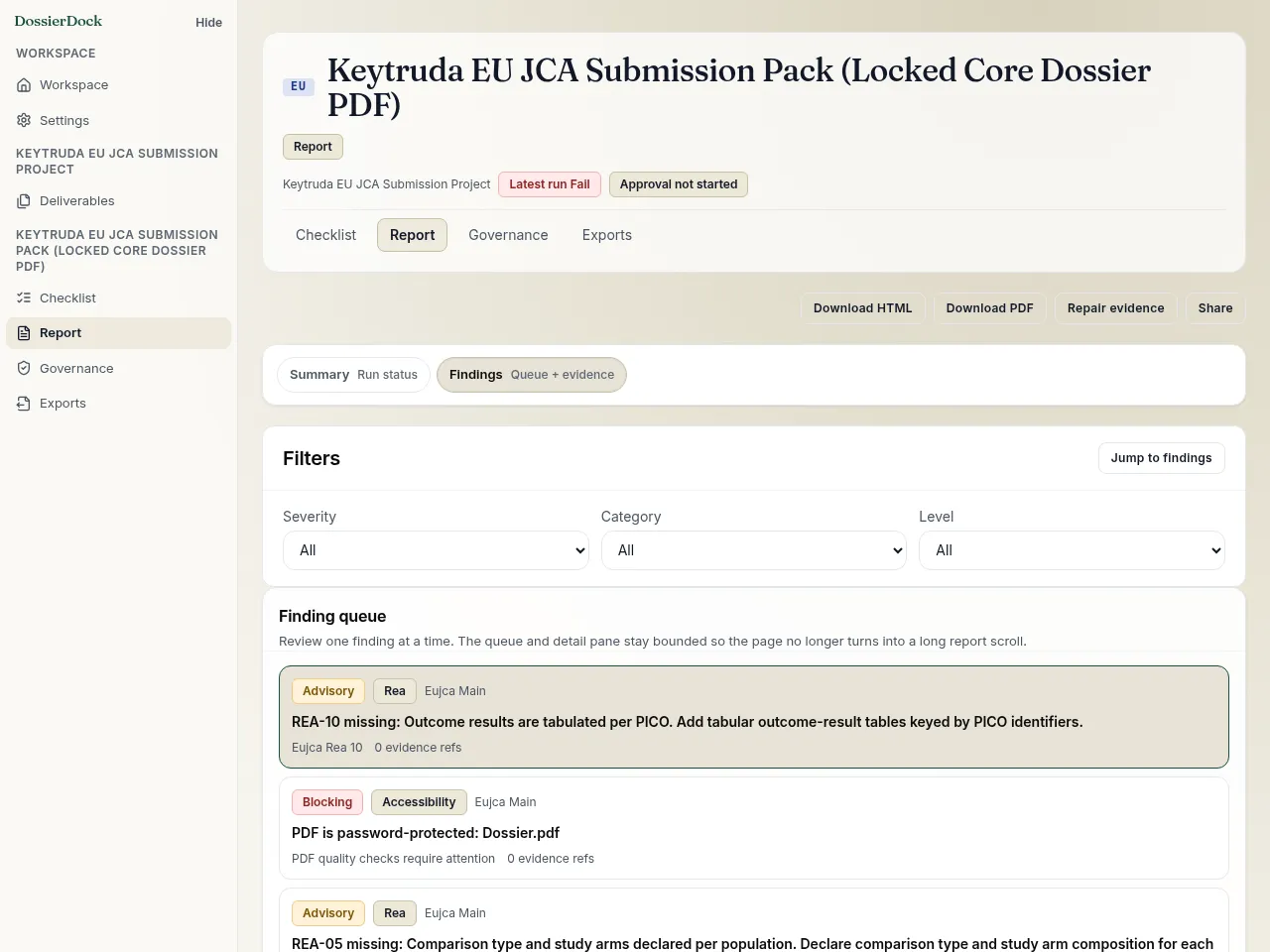
Named checks
Clear report output
Review invalidation
Approvals tied to current inputs
Secure sharing
Internal report and frozen-review links
Governed exports
Package records, file fingerprints, and traceability
Start from the deliverable that actually needs attention.
Operators land in a workspace and project dashboard that show run health, must-fix issues, readiness, and the safest next step. New work starts through a guided onboarding flow that sets the template, channel checks, review threshold, and first upload.
- Workspace triage across deliverables and projects.
- Project dashboard for readiness pressure and last approved export context.
- Guided onboarding wizard for project, deliverable, and first upload setup.
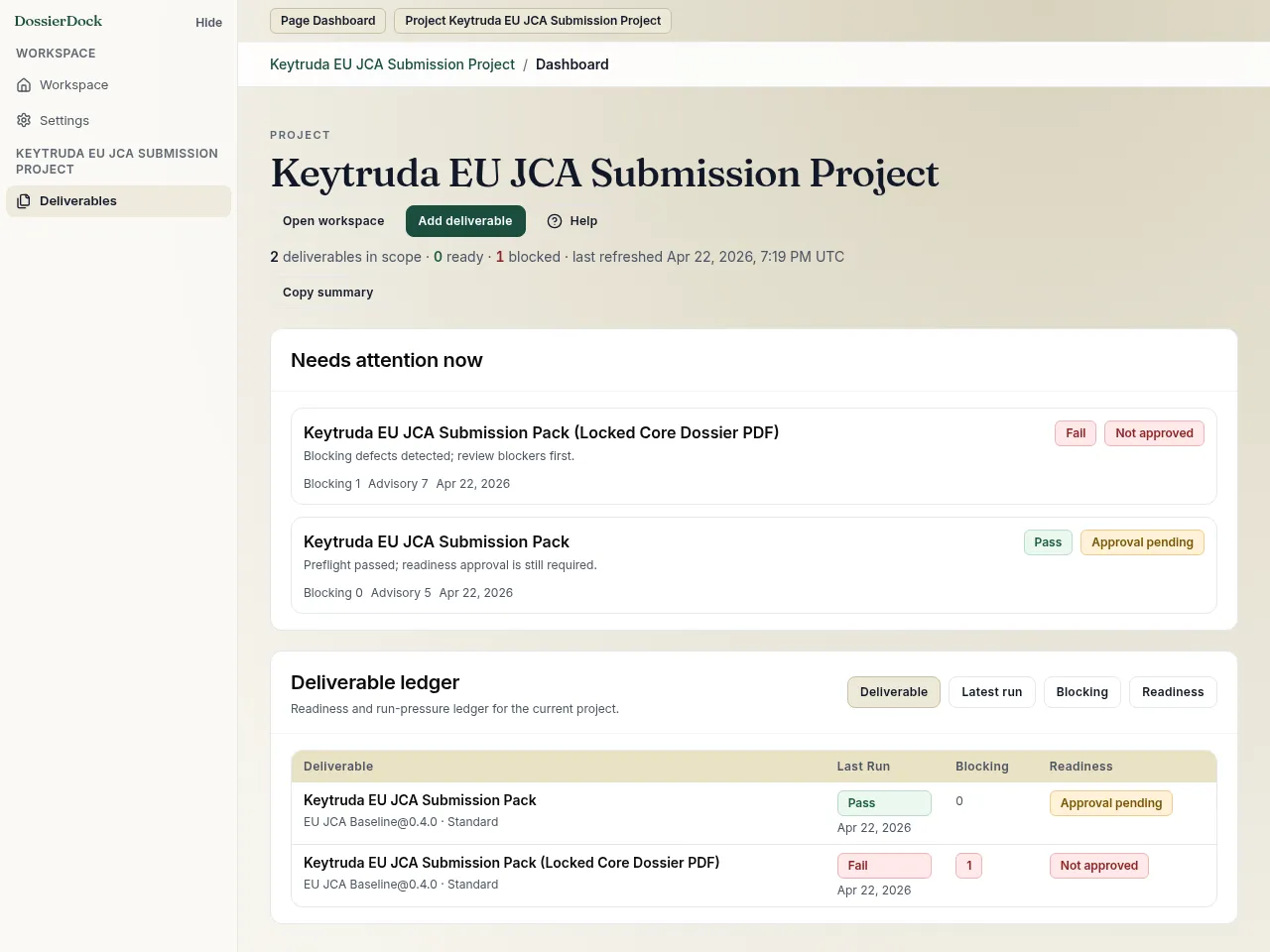
One operator flow, channel-specific enforcement.
Each channel has its own template, checks, and pass threshold. The working path stays stable while the enforcement logic changes by market and organization.
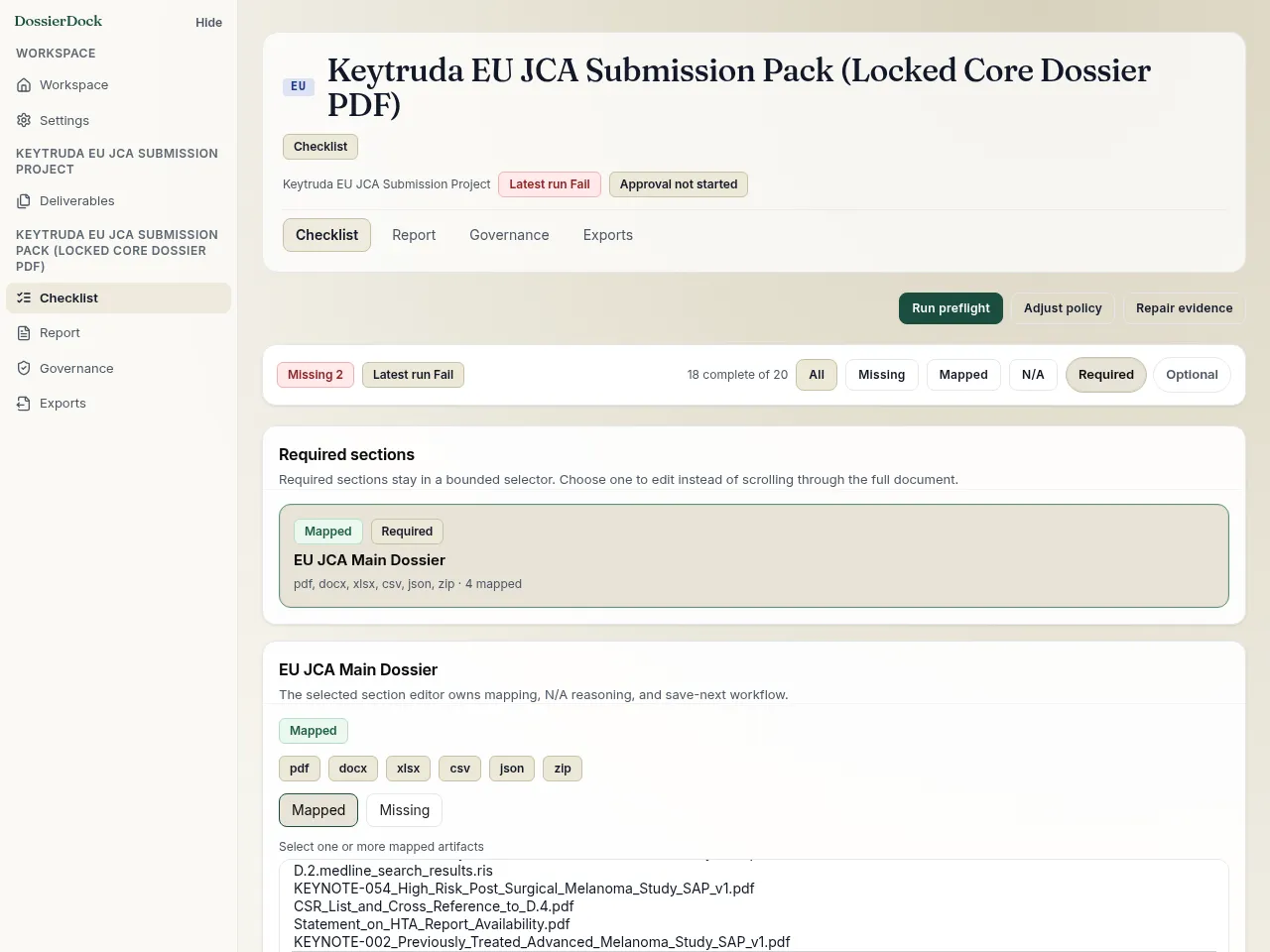
Catch defects before they cost you a cycle.
DossierDock runs your submission pack against channel-specific checks, not generic checklists. Findings are explicit, reproducible, and tied to named checks, with guidance written for the analyst doing the fix. The current channel-facing check sets carry 94+ rules and stay versioned to their source authority.
- Required sections mapped or marked N/A, file openability, password-protected PDF detection, filename conventions, and packaging constraints.
- Cross-section agreement for cutoff dates, primary endpoint names, and sample sizes.
- Table structure checks for required columns, headers, and referenced data tables.
- Deeper cross-reference and content-aware checks are precision-gated and only enabled where trust is acceptable.
Readiness approvals stay bound to current inputs.
DossierDock does not treat approval as a one-time checkbox. Governance ties readiness to the current run and mapped input set, then invalidates approval when those inputs change.
- Role-based access (Admin, Editor, Reviewer) per project and deliverable.
- Unified findings queue plus section- and run-aware review detail.
- Readiness gates with automatic invalidation when mappings or artifacts change.
- Override approvals with recorded justification, approver identity, and timestamp.
- Comments and tasks on sections and defects.
- Immutable audit event log.
- Notifications for must-fix findings, approvals, mentions, and stale approval state.
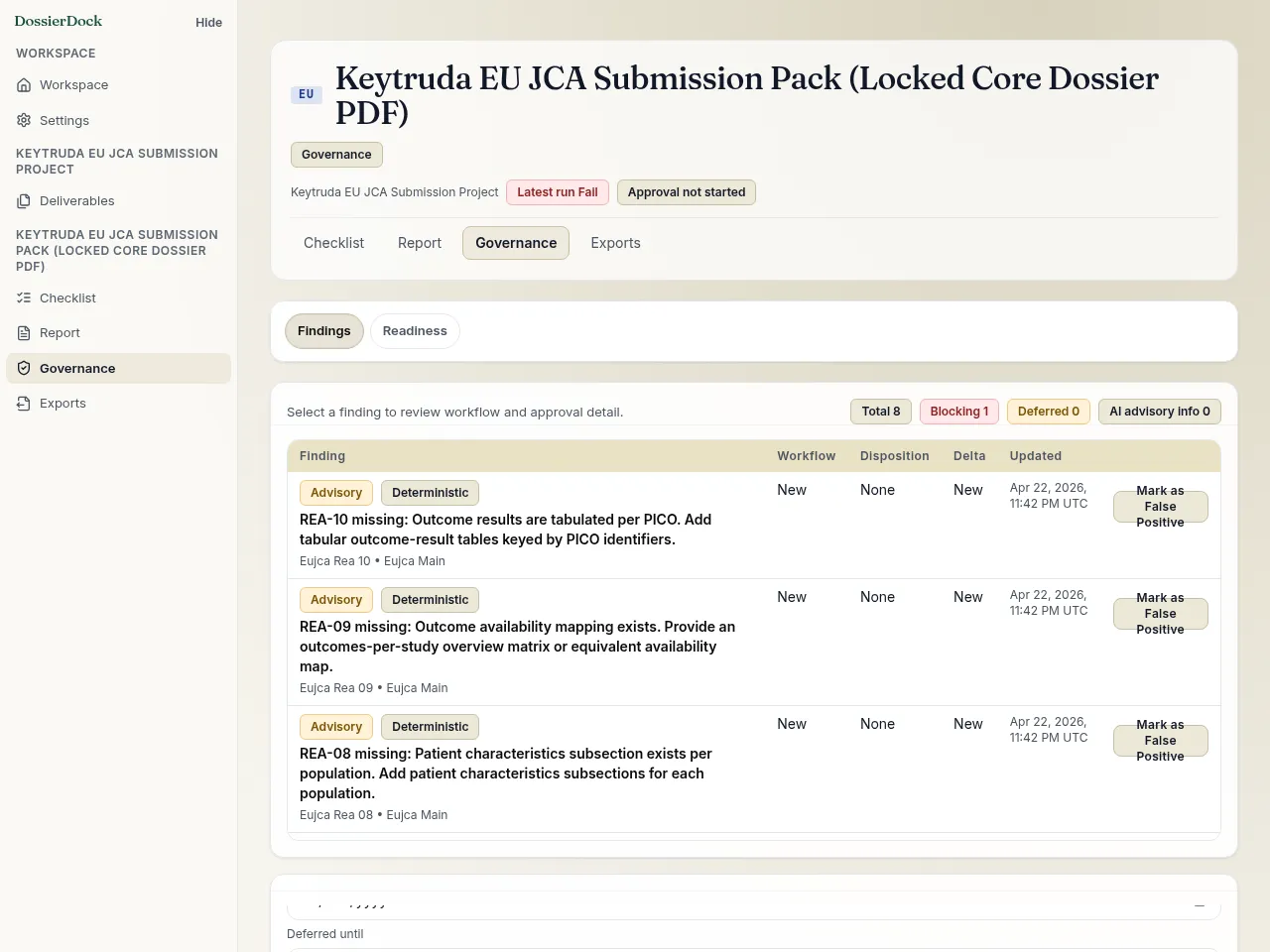
Share findings safely, then build governed exports.
The current product supports secure internal report sharing plus governed working, review-snapshot, and submission export flows. Export state stays tied to readiness and the selected review run.
- Internal report share links with expiry, RBAC, and audit.
- Review-snapshot links for frozen review artifacts.
- Repeatable ZIP packaging so the same approved inputs produce the same export package.
- HTML index with package inventory and export details.
- File fingerprints for every exported artifact.
- Signature verification and export history tracking.
- Germany-specific portal-aligned ZIP layout (Modul roots at ZIP root, no wrapper).
- Direct traceability CSV and XLSX downloads.
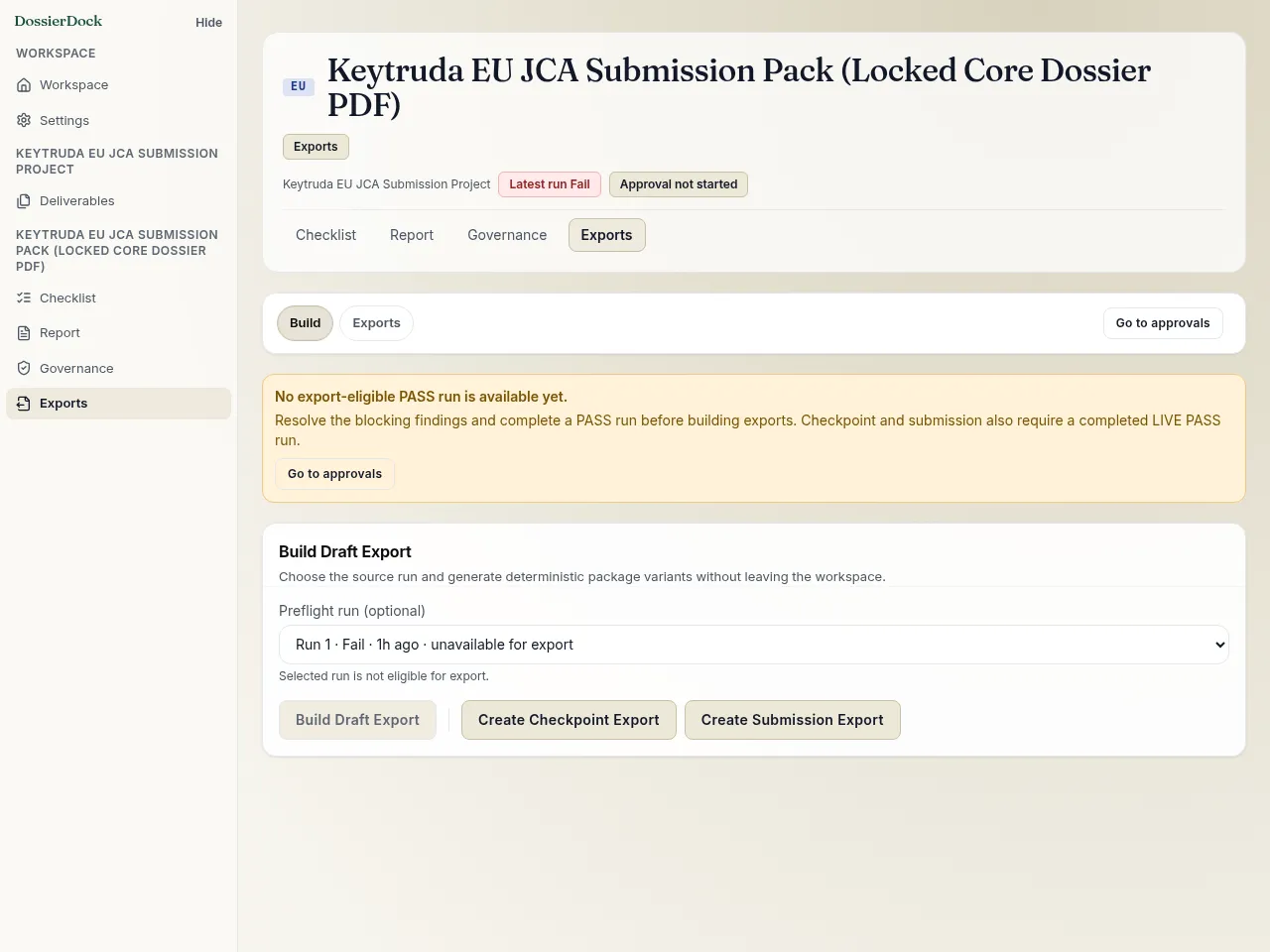
Deeper surfaces stay available without crowding the operator lane.
Evidence repair, policy work, tenant admin, and AI advisory are real parts of the product. They stay outside the daily submission path so operators can focus on setup, review, approval, and export.
Repair and market-specific review when needed.
Evidence, policy, claims, and PICO surfaces exist for deeper repair, coverage work, and EU-specific review without turning every deliverable into a full research workspace.
Enterprise controls live outside the operator lane.
Access configuration, market-specific settings, security posture, retention controls, audit export, and procurement-response tooling stay in tenant-admin surfaces instead of the core workflow.
AI can assist, but it does not govern state.
When enabled, AI appears as advisory alongside rule-based findings. It does not approve readiness, mutate workflow state, or replace preflight and export controls.
Current settings overview keeps only pilot-relevant admin entry points in the default lane.
See the current product on a real workflow.
Walk through the live operator path against the work your team actually does today.